Sunday, April 10, 2022

Swapping Surname Confusion - The Impact of Religious (But No Civil) Marriage

In many parts of Austria-Hungary (including Galicia, Maramaros, Bereg, and many more megye), Jews would often have religious marriages but wouldn't register their marriages civilly.  This meant that while the community considered the couple fully married, the government considered their children illegitimate, and those children would generally have to use their mother's surname.  Sometimes people would marry civilly many years after their religious marriage because it was needed for some purpose, and this would retroactively legitimize their children.  (I saw this in my own family, when my great-great grandparents had a civil marriage after they were already grandparents.)

There are many implications for this in genealogy.  It means that yDNA, which generally follows the surname line, does not do so in these cases.  Sometimes, children of such a marriage would vacillate between using their father's surname and their mother's surname.  Sometimes an individual who used his or her mother's surname in Europe would immigrate to America and begin using his or her father's name.  An example of a confusion I've seen in my own family was with my great grandmother's first cousin Roza.  Her surname use teaches an important lesson for making sure that you don't overlook records for an individual from this part of the world.

Marriage of Roza Fuksz to Jakob Steinmetz, Maramaros-Sziget, Hungary (now Sighetu Marmației, Romania), 1914

Friday, April 1, 2022

Diamond Emigration Anniversary - and Diamonds' First US Census

On April 1, 1947--75 years ago today--my Diamond grandparents and my Baich/Bajcz great grandmother came to America.  And today, April 1, 2022, the day that the 1950 census became publicly available, I was able to see them on their first-ever United States census, along with my father's older brother Abe, age 2.  (The census becomes publicly available on the April 1 that is 72 years after the census was taken.)

Diamond/Baetz in the 1950 Census (Paul Diamond inserted from end of previous page).  Baltimore, Maryland

Sunday, March 13, 2022

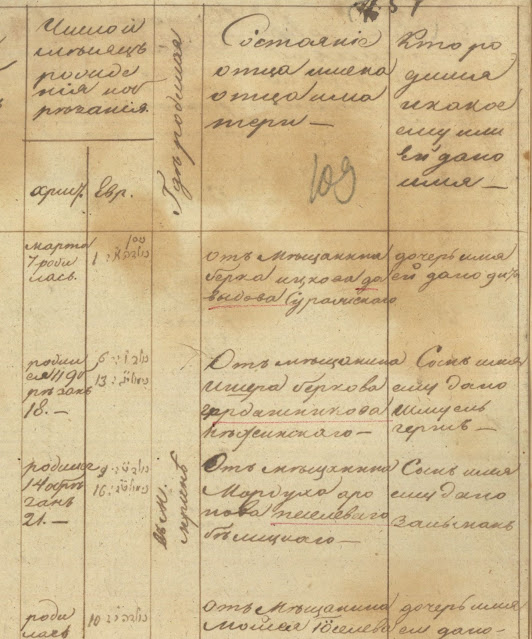
Nizhyn & Kozelets 1836 Metrical Records

I've written about my family who lived in and around Nizhyn, Ukraine (then Nezhin, Russian Empire), which has been in the news lately in a not-good way.  Right before the Russian invasion, I was working with the Chernihiv archives (another town unfortunately in the news) to get digitized versions of the few years of metrical (vital) records for the Nizhyn Jewish community that hadn't yet been digitized by FamilySearch.  (If you want to look at the incredible set of already-digitized records, check out my quick guide here.)  About a week before the Russian's invasion, I received Nizhyn's 1836 birth records as well as all 1836 metrical records for Kozelets.  I was working on getting 1841's, but those will have to wait until the Russians are beaten and things settle down for the people working in the archive.

A sample page of Nizhyn metrical records

Tuesday, March 8, 2022

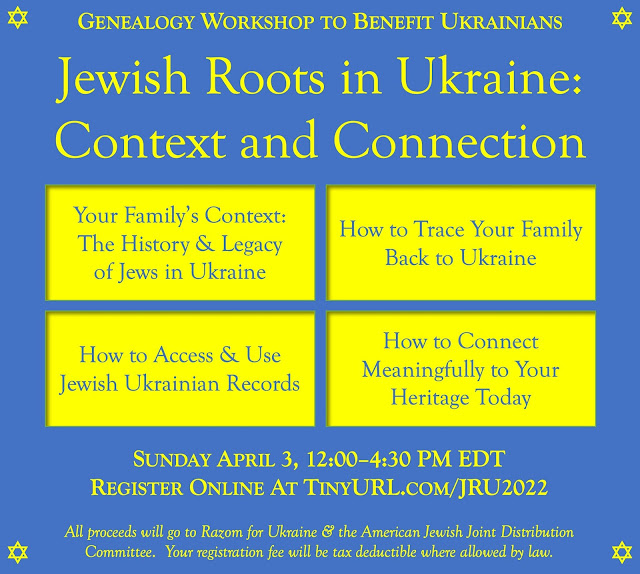
One-Day Workshop to Benefit Ukrainians/Jewish Roots in Ukraine: Context and Connection

I'm thrilled to partner with Tammy Hepps, Brooke Schreier Ganz and Jennifer Mendelsohn to offer a workshop on Jewish roots in Ukraine, with all proceeds going to Razom for Ukraine and the American Joint Distribution Committee, who are assisting Ukrainian refugees.

Sunday, February 13, 2022

Jewish Eviction from Towns within the Russian Empire

My second cousin four times removed was Feiga Lefand, who lived in Drozdovka, near Nezhin in Chernigov Guberniya, Russian Empire (currently Drozdivka, Ukraine).  My 5th great grandparents (and Feiga's great grandparents) had received permission to move there based on an 1853 request (which led to the authorities trying to draft Lefand kids and multiple years of petitions that I've written about here).

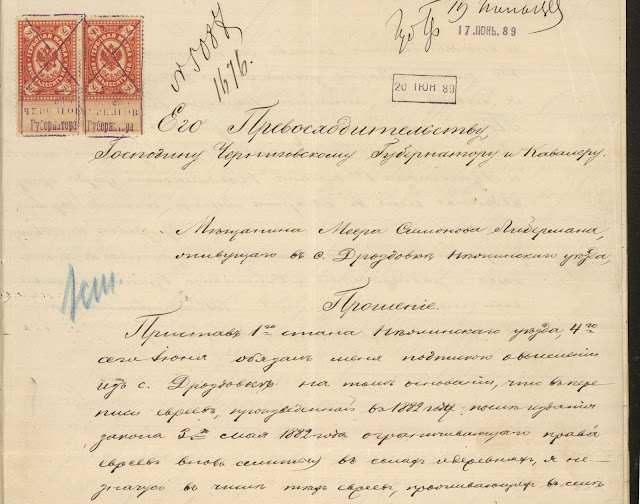
In 1885, Feiga married Meir Lieberman, and they lived in Drozdovka as well.  In the 1888 census, they had two young children, Simon and Dvora.  But then in 1889, Meir was evicted from Drozdovka because he didn't have permission to be living there.  He appealed his eviction and left us some insight into what Jews needed to deal with when living in the Russian Empire in the 1880s.

Part of the case related to Meir Lieberman's forced eviction from Drozdovka

Sunday, January 30, 2022

Using DNA Painter - When You're Jewish

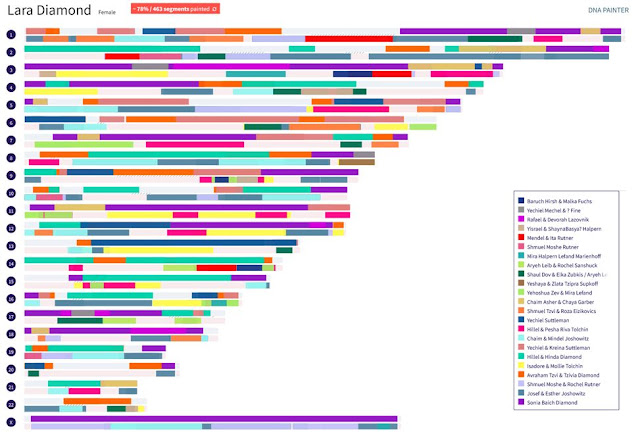
DNA Painter is a very cool tool that allows you to visualize DNA that you inherited from specific ancestors.  But when you're from an endogamous population like I am, there are some potential pitfalls for which you need to account.

DNA I Inherited From Different Ancestors

Sunday, January 16, 2022

My Great-Great Grandmother Voted - How I Discovered That and Her Birth Year

My grandmother Sonia was close to her paternal grandmother Ronia.  In fact, when Sonia's parents moved to the village where her maternal grandfather lived, my grandmother and her sister remained in the city of Horochov with Ronia.  Ronia was a city woman who did not want to move to a village, and the girls stayed with her to continue at their school.  (You can read my grandmother's perspective on that time here.)  In any case, I had no documentation of Ronia's life, other than what my grandmother had told me about her.

Recently on JewishGen, there was a post about "Documents from Volyn, Ukraine."  Since my father's parents are both from Volyn (Volhynia), I took a look.  This post mentioned a site (https://en.volynia.com/) with indexes of various documents from this area.  The site lists surnames included in each set of documents and in the list of those registered to vote in Horochov in 1938 there was a Bajcz--my grandmother's maiden name.  I reached out to the site owner and asked if this was Avraham Bajcz, my great grandfather.  He said it wasn't--but it was a woman named Bronia.  Hmmmm.....  Bronia/Ronia were very very similar.  I ordered a copy of that record.

Bronia Bajcz Voter Registration