Showing posts with label DNA. Show all posts

Monday, August 1, 2022

Ashkenazic Shared DNA Survey - August 2022 Update

Thank you to everyone who has contributed data about shared DNA in people with Ashkenazic ancestry!  I have 6455 data points to analyze, and that should help the entire genetic genealogy community  (I'm still collecting data--you can find out more about the project and how to contribute here).


This iteration looks at how shared DNA will differ depending on how much (documented) Ashkenazi DNA each individual has.

Thursday, April 14, 2022

Those Small DNA Percentages - They're Always Real, Right??

With the latest AncestryDNA update, I'm no longer predicted to be 100% "European Jewish," which had been unchanged for several years--and totally matches my paper trail.  (A while back I did have a random 1% Finnish, which disappeared.)  But as of this week, I'm down to 98% European Jewish, along with 1% Norway and 1% Baltics.  Does this mean that I need to start tracing where that 1% came from?  Are these small percentages always real?  Wouldn't it be the case that updates are more accurate than prior predictions?

My Ethnicity Estimate as of April 2022, Ancestry.com

Sunday, January 30, 2022

Using DNA Painter - When You're Jewish

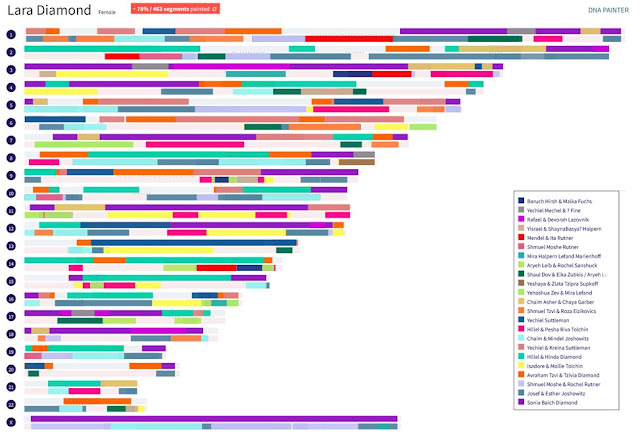
DNA Painter is a very cool tool that allows you to visualize DNA that you inherited from specific ancestors.  But when you're from an endogamous population like I am, there are some potential pitfalls for which you need to account.

DNA I Inherited From Different Ancestors

Sunday, December 5, 2021

Family Stories Vs Documents & DNA

My father's parents were both Holocaust survivors and didn't have much close family, especially on my grandmother's side and on my grandfather's father's side.  The two "Schwartz" brothers, also Holocaust survivors, lived in New York and would always come down to Baltimore for our family celebrations, and my grandparents would go to New York, since they were some of the few relatives on my grandfather's Diamond side who had survived.

My grandfather had told me that these "Schwartz" brothers (I'm using a pseudo surname, as requested by the surviving brother) were related through their mother, whose maiden name was Reiza Diamond, and that Reiza's father Yankel was a sibling to my grandfather's grandfather Hillel, making the Schwartz brothers second cousins to my grandfather.

But DNA disagreed.  As did some documentation.

Yankel Diamond, Grandfather of the "Schwartz" Brothers

Sunday, November 28, 2021

A DNA Match is Only the Start - Using the Paper Trail to Find the Connection

DNA results don't generally tell you how someone's related.  You can use a match as a clue that someone is related to you, and then you can use other matches along with a paper trail to try to find the actual connection.  And when dealing with Jewish ancestry, endogamy comes into play in a major way.  Recently, a new match popped up which was intriguing--this person (listed with just initials) on GedMatch matched multiple people on my maternal grandmother's side, some with large shared segments.  Since my grandmother's parents were from what's now Subcarpathian Ukraine, I was pretty sure that this person would have had similar ancestry.

Here's how I took a DNA match and have been able to almost figure out our relationship.

I reached out to Moshe, whose email address was associated with this match, and he told me that the DNA was that of his grandmother, Malka.  He had a few of her ancestral surnames and locations.  I could rule out her Lithuanian ancestors as being our connection, but the Czech ones sounded more intriguing, since this part of the world was Czechoslovakia between WWI and WWII.  He didn't have towns of origin, though.
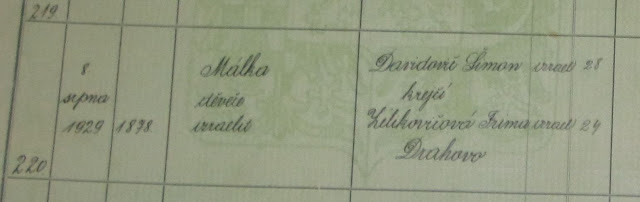
I located Moshe's great-great grandmother's birth registration

Tuesday, July 14, 2020

Longest Segment Coming on AncestryDNA!

If you are from an endogamous population, you're used to getting predicted "close" relatives that aren't really so close after all because of endogamy.  One of the best strategies for determining if a match is truly worth pursuing for us endogamous people is looking at the size of the largest segment, since many small segments may be artifacts from being related in many ways on many lines, pretty far back.  Most of the large genealogical testing companies give the size of the largest segment, but AncestryDNA hasn't done so. 

I've accosted Crista Cowen at many genealogy conferences for years (sorry Crista) with my largest segment plea; in fact, I was thinking that Crista appreciated Covid stopping in-person genealogy conferences for now so I can't bother her in person.

But Ancestry has come through!!

Monday, May 25, 2020

Some Fine DNA

Back in 2013, I wrote about a potential new branch of the Fine family.  My grandmother had told me how her uncle Mordechai had come to America but had been sent back to Russia, where he was drafted into the Russian Army and killed in WWI.  On his ship manifest, he said he was going to an uncle, "Meyer Fein," in Toledo, Ohio, a totally new name to me (although I did know of Toledo Fine cousins).  I traced this Meyer back to England, where he'd lived and married after emigrating from Russia.  And his father lived with him--could this be my great-great-great grandfather?

As background, I wrote up tracking down this Fein/Fine family in a series of posts:
I found out a lot about this family, including via an 1891 British census, where Meyer (there Myer Fein) is enumerated along with his father.  Hmmmm.....
1901 England Census, Hebel and Myer Fein, London
But I recently got in touch with someone who I thought could help answer that question.

Sunday, September 1, 2019

Ashkenazic Shared DNA Survey - September 2019 Update

An updated version of this post is here.

Thank you to everyone who has contributed data about shared DNA in people with Ashkenazic ancestry!  I have 5537 data points to analyze, and that should help the entire genetic genealogy community  (I'm still collecting data--you can find out more about the project and how to contribute here).

This iteration looks at how shared DNA will differ depending on how much (documented) Ashkenazi DNA each individual has.

There are four tables below:
  • Table 1 looks at all 5337 data points, regardless of Ashkenazic percentage
  • Table 2 looks at those data points where both individuals are documented to be 100% Ashkenazic
  • Table 3 looks at those data points where one individual is documented to be 100% Ashkenazic and the other 50% Ashkenazic
  • Table 4 looks at those data points where both individuals are documented to be 50% Ashkenazic 
  • Table 5 looks at those data points where one individual is documented to be 100% Ashkenazic and the other 25% Ashkenazic
  • Table 6 looks at those data points where one individual is documented to be 50% Ashkenazic and the other 25% Ashkenazic

Sunday, May 26, 2019

Visualizing your Tree - With Expected Autosomal & X DNA Shared

I've mentioned the very cool Exploring Family Trees tool before, which allows you to upload a Gedcom file and quickly visualize your family tree.  I just uploaded a new Gedcom file and noticed that some useful features have been added, which can help you understand how much DNA you may have inherited from a particular ancestor.
Descendants of Avraham Rutner, my 5th great grandfather

Monday, April 22, 2019

Supcoff/Soupcoff - DNA Proof

I've been trying for years to connect the Soupcoff family who ended up in Pittsburgh with my Supkoff family, who also ended up in Pittsburgh.  My grandfather had been told that they were some kind of cousins, but he didn't know how.  I've extensively researched both lines but never found that link, although it did appear that both lines had originally been Zubkis.  Recently, with records that Alex Krakovsky has been putting online, I found references to various Zubkis families.  In September, I wrote about a document I found enumerating a Zubko family in Gaysin in 1850, adjacent to the town of Kuna where my Zubkis family lived.  I was pretty sure that the Gershko who headed this household was the brother of my 4th great grandfather.
Zubka Family, 1850, Gaysin

Sunday, April 14, 2019

Now THAT'S a Large Segment

My parents recently took 23AndMe tests (thanks to them for humoring me yet again).  My mom's came back in record time, while my father's is still processing nearly a week after my mother's finished.  Looking at my mother's matches, there was one that looked really interesting:
My mother's shared DNA with Natalie

Tuesday, March 26, 2019

DNA From Which Parent?

Some of the DNA companies will tell you which side a match is from if one or both of your parents have tested with that same platform.  I'd tested with 23AndMe back in 2013, but both of my parents only just tested.  My mother's results came in today, but we're still waiting for my father's.

But since only my mother is in the system at this point, 23AndMe is looking at all of my matches and trying to predict through which parent we are connected.  Well, this might work really well if you're not from an endogamous population, but if you are, it isn't so helpful.
My closest matches on 23AndMe.  Check out the prediction between each relationship--all on the mother's side!

Sunday, March 24, 2019

A DNA Connection--Or Rather, Connection_s_!

Back in November 2018, I was going through my 23AndMe results.  Because I'm 100% Jewish, endogamy causes me to have a ton of predicted close matches, so I was concentrated on those with open sharing, so that I could look at the size of our largest shared segment as well as those where known relatives who have tested also shared a large total amount of DNA.  One of the people I messaged was MC.
Message Sent to MC in November 2018

Sunday, January 13, 2019

mtDNA Success!!

Mitochondrial DNA (mtDNA) is passed down the direct maternal line.  mtDNA mutates very infrequently, so people (especially people from closed communities like Ashkenazim) tend to have dozens--or hundreds--of exact mtDNA matches, and those matches may be from common ancestors hundreds or more years back.  Some people dismiss mtDNA as being of much genealogical use.  But sometimes it can help you find another branch of your family, and it's just done that for me.  (And as I was in the middle of writing this, Roberta Estes posted about her own recent mtDNA success.)

Back in the summer of 2016, I wrote about how my mother had only one exact mitochondrial match, a man named Michael.  At the time, I noticed that while Michael was an exact match, they both had over 200 matches with one mutation's difference from both of them.  (Two-and-a-half years later, Michael is still my mother's only exact match, and they have over 380 matches with one mutation.)  In 2016, I recognized the name of one of those 200 distance-one matches and asked her how many exact matches she had.  It turned out that every one of those distance-one matches was an exact match to her mtDNA.  So I hypothesized that Michael and my mother were descended from one woman who relatively recently had a mutation that differentiated her mtDNA from the mtDNA shared by those 200+ people
My mother's mtDNA matches in 2016

Sunday, December 16, 2018

DNA Hinting At Ancestral Origins?

Genetic genealogy doesn't exist in a vacuum.  Many people who take DNA tests assume that their results will come with a fully populated (and maybe even documented) family tree back generations.  While DNA doesn't work like that (unless you are a good match to me), it can point you to places to do additional research, that you may not have known about otherwise.

Last Sunday, I got a message through MyHeritage from a woman named Kathy who said that many of my kits matched her sister-in-law Dorothy.  Generally when I get messages like this, I ask which kits match, and then I get to respond that they are from various lines of my family and are not related to one another, and I explain about endogamy.  But her response was different.  Everyone that Dorothy's kit matched was related on my maternal grandmother's side.  So I took a look.
Chromosome 3 - Shared segments between Dorothy and my family

Sunday, November 4, 2018

The Rosenfeld Connection - Test Everyone!

I recently received an email from a woman named Susan.  Susan had asked her first cousin Francine to take a DNA test, and when Susan uploaded Francine's results to GedMatch, she noticed that Francine shared a very large segment with two kits I administer--for my cousins Berly and Paula.

Berly and Paula are first cousins to my father through their Diamond mother, and they are sisters to one another.  My initial thought was that the connection was going to be through their father, and I was going to forward the email onto them.  But I looked at Francine's results first.  Right away, I realized that this shared DNA was via my Diamond side; both my father's first cousin Stephen (also a first cousin to Berly and Paula) as well as their second cousin once removed, Patty, all shared relatively large segments of that same chromosome.
DNA Shared by Francine & My Known Relatives


Thursday, May 10, 2018

My Genetic Genealogy Interview, WBAL-TV

A few weeks back, I was interviewed by Mindy Basara of WBAL-TV, Baltimore's local NBC affiliate, on genetic genealogy.  The result aired last night.


Sunday, May 6, 2018

Ashkenazic Shared DNA Survey: Data by Ashkenazic Percentage

An updated version of this post is here.


Thank you to everyone who has contributed data about shared DNA in people with Ashkenazic ancestry!  I have 4990 data points to analyze, and that should help the entire genetic genealogy community  (I'm still collecting data--you can find out more about the project and how to contribute here).

This iteration looks at how shared DNA will differ depending on how much (documented) Ashkenazi DNA each individual has.

There are four tables below:
  • Table 1 looks at all 4990 data points, regardless of Ashkenazic percentage
  • Table 2 looks at those data points where both individuals are documented to be 100% Ashkenazic
  • Table 3 looks at those data points where one individual is documented to be 100% Ashkenazic and the other 50% Ashkenazic
  • Table 4 looks at those data points where both individuals are documented to be 50% Ashkenazic

Wednesday, April 25, 2018

Painting my DNA - Happy DNA Day!

Happy DNA Day!  I've posted before about mapping out which segments of my chromosomes could be attributed to specific ancestors.  But there's a new tool out which makes doing this even more straightforward!  Check out DNA Painter.
My Painted DNA Segments, April 2018

Sunday, February 18, 2018

Some Day I'll Find It, The Mitchneck Connection: Using Lazarus to Predict Relationships

I've mentioned before that various family members have stated that we were related to Simon Mitchneck, a famous Hollywood voice coach.  I've written about finding letters from Simon's sister enclosed in Simon's passport applications that spoke about the family's desperate situation in the aftermath of World War I.  Records of Simon and his three brothers (who emigrated to America) consistently named their father as Shia and their mother as Leah/Lea Goldberg/Goldenberg.  I do know that they do have some sort of connection to the Halper family (which also may be my great-great grandmother's maiden name).

And back in December, I wrote about how Simon Mitcheck's great nephew contacted me after seeing his family discussed on the blog--and how the DNA that the great nephew shared with known descendants of Hillel and Hinda Diamond demonstrated that the family stories of a relationship were correct.

After seeing this post, Simon's nephew "M" (the father of the gentleman who contacted me) agreed to test.  His results came in, and again, there are multiple large segments shared with varying descendants of Hillel and Hinda Diamond.  Descendants of Hillel and Hinda Diamond share anywhere from 7.3cM to 119.6cM with him, so predicting the true relationship is difficult--particularly because we are dealing with Ashkenazic Jewish DNA, which is intrinsically endogamous.  (In the chart below, D, L, Berly, Paul & Stephan are 100% Ashkenazi; Beth and David are 50% Ashkenazi; Liz, Patty and Debra are 25% Ashkenazi; M is 100% Ashkenazi.)
DNA Shared by Tested Descendants of Hillel & Hinda Diamond with M.  (Orange boxes represent tested individuals)